Visual Biography

A Life Lived
Brief, Beautiful, and Unforgettable!
A Visual Biography of Moshope Oyeyemi
A Portrait of a Life That Continues to Speak
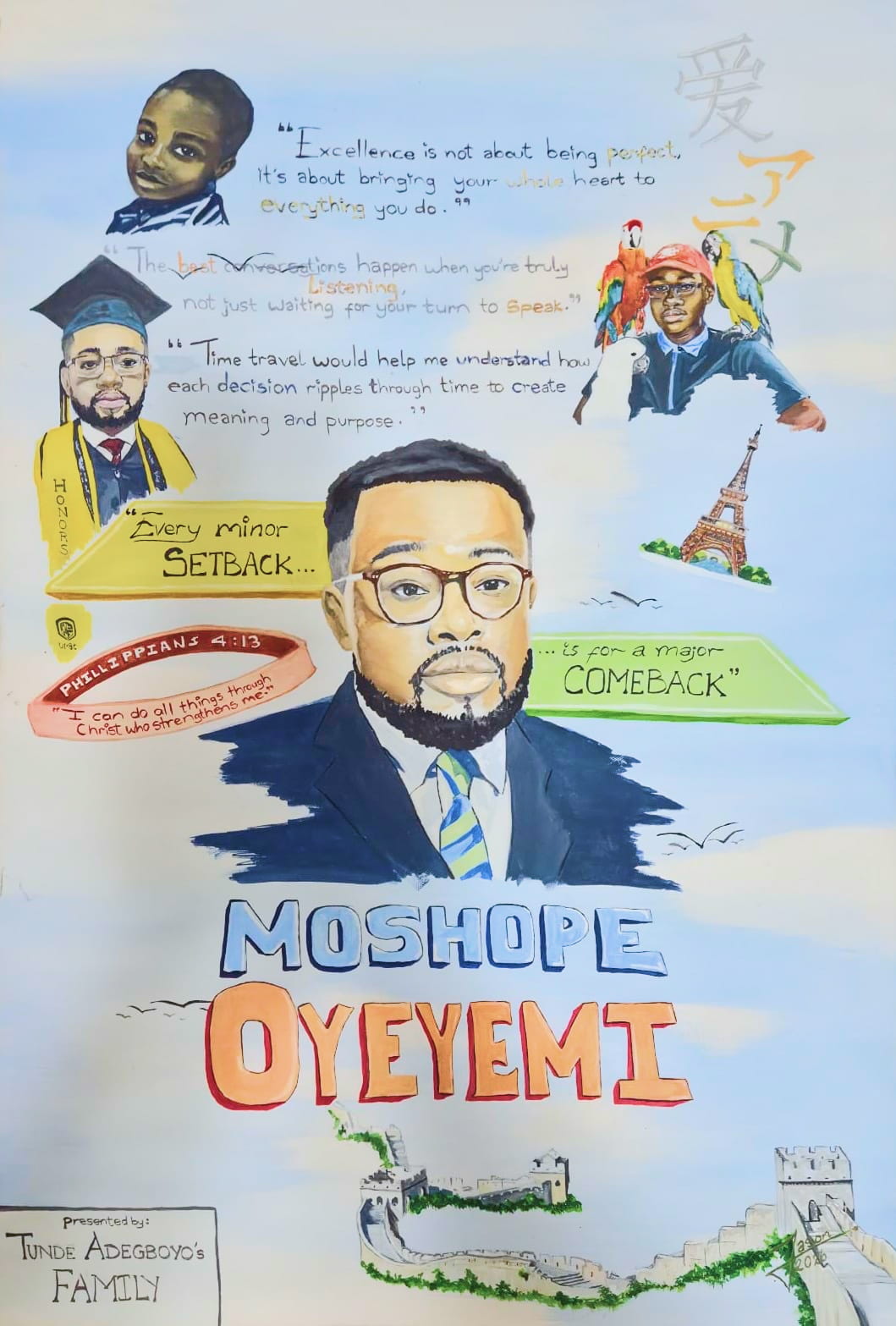
The canvas remembers: how one painting holds twenty-five years of a life that etched itself into everyone it touched

The Painting: An Overview

Before us is not merely a painting. It is a biography rendered in color, composition, and conviction, a visual eulogy of a young man whose 25 years on this earth burned with the intensity of a thousand lifetimes. Commissioned by Sade and Tunde Adegboyo and executed by Jason Egbagbe, a 16-year-old artist of extraordinary perceptiveness and skill, this acrylic-on-canvas work is a meditation on legacy, love, faith, ambition, and joy. It honors the life of Moshope Oreoluwa Oyeyemi, born February 18, 2000, in Queens, New York, a young man his family described with devastating simplicity:

"You lived like a sunrise — brief, beautiful, and unforgettable."

That Jason Egbagbe was only 16 when he created this work makes the painting all the more remarkable. A teenager, looking at a life cut short, chose not to paint grief. He chose to paint fullness. That decision alone is the first and most profound statement the artist makes.

The Composition: Architecture of a Life

The painting is structured as a collage of biographical vignettes arranged around a central, commanding portrait, a deliberate compositional choice that speaks to how Moshope himself moved through the world: as the gravitational center of every room, every relationship, every moment he entered. Everything in the painting orbits him, just as people orbited him in life. The background is a luminous sky of soft blues and drifting clouds, an environment of openness, possibility, and elevation. There is no darkness here. No shadow. The world in which Jason places Moshope is one of light, breath, and sky, as if to say:

this was a man who lived above the ordinary.

The Central Portrait: The Man He Became

At the heart of the canvas stands the adult Moshope, suited, bespectacled, bearded, and composed. He wears a dark blazer, a striped tie, and an expression of quiet authority. This is the professional, the Morgan Stanley analyst-turned-associate, the young man whose colleagues wrote that he was

"more than just a colleague - he was a mentor, a visionary, and a friend."

His glasses frame eyes that, even in paint, carry both intelligence and warmth. His beard and his composure speak of a young man who had grown fully into himself. Jason paints him not as a victim of time, but as a man, complete, realized, sovereign in his identity. This is an act of profound artistic respect: to refuse to reduce the subject to his absence and instead celebrate the presence he carried in life.

The Younger Portraits: The Arc of Becoming

Flanking the central figure are two additional depictions of Moshope at earlier stages of his life, and together the three form a narrative triptych, a visual timeline of growth, maturation, and becoming. In the upper left, a young boy gazes back at the viewer with an expression both serious and luminous, the child who was described by his family as

"a bubbling fountain of joy, a tiny force of nature with an innate positivity."

This is Moshope before the world knew his name, already radiant, already himself. In the middle left, Moshope appears in his UMBC graduation regalia, mortarboard, golden honors stole, beaming with earned pride. The UMBC insignia is subtly visible, grounding this moment in real achievement. This is the scholar who charted his own path through Penn State and UMBC, who fused Information Technology and Finance into a singular calling, who walked into Morgan Stanley as an intern and walked out with a full-time offer before graduation. The honors stole he wears is not decorative, it is documentary. It records what he accomplished.

On the upper right, Moshope stands with colorful macaws perched beside him, dressed casually and brilliantly. This is Moshope the traveler, the adventurer, the man who flew alone to foreign countries simply to experience new cultures, new cuisines, new ways of being human. His friend Mike recalled:

"He had a sense of adventure unlike anyone I knew. He traveled by himself to other countries just to experience a different culture, people, and cuisine."

The parrots, vivid, exotic, wild, are perfect symbols for a man who sought the extraordinary in every corner of the world.

The Words: His Own Voice, Preserved

Jason Egbagbe makes one of the most powerful artistic choices in the painting by inscribing Moshope's own words directly onto the canvas. These are not invented epitaphs. They are Moshope's actual recorded statements, and they deserve to be read slowly:

"Excellence is not about being perfect, it's about bringing your whole heart to everything you do."

This was his philosophy of living, the framework through which he approached school, career, relationships, and faith. He did not demand perfection from himself or others; he demanded wholeness. He demanded presence. He demanded heart.

"The best conversations happen when you're truly listening, not just waiting for your turn to speak."

This reveals the emotional intelligence of a man who made strangers feel seen and friends feel deeply cherished. His colleagues at Morgan Stanley wrote about how he prioritized people, how he was curious about what others did, why they did it, and why it mattered. This quote is not just wisdom; it is autobiography.

"Time travel would help me understand how each decision ripples through time to create meaning and purpose."

Drawn from a Morgan Stanley team spotlight interview published December 12, 2022, this statement is perhaps the most poignant in the entire painting, given what we now know. In that interview, when asked what superpower he would choose, Moshope chose time travel, not for selfish gain, but to solve world hunger, to achieve world peace, to make things better. He wanted to understand cause and effect across centuries. He wanted to see how every decision creates consequence, meaning, and beauty. Jason Egbagbe preserves this quote as both revelation and elegy.

The Signposts: "Every Minor Setback... is for a Major Comeback"

Two diagonal arrow-shaped banners cut dynamically across the lower-left portion of the canvas, one yellow, one green, bearing a statement that defined Moshope's resilience:

"Every minor SETBACK... is for a major COMEBACK."

These are not passive sentiments. They are declarations of war against despair. They speak to a young man who encountered obstacles, transferring schools, navigating new environments, building a career in finance, and who refused to interpret any of it as failure. His family wrote that they watched him "rise to every challenge" and excel in "everything he set his mind to." The diagonal trajectory of these signs is itself meaningful: they are not horizontal, not static, they point upward and forward, always.

The Scripture: Faith as Foundation

Winding alongside those banners is a red ribbon bearing the scripture:

Philippians 4:13 -
"I can do all things through Christ who strengthens me."

This was not a decorative choice. This was Moshope's literal lived reality. His family documented how he wore scripture on his wrist like a "sacred badge," pasted verses on his room walls, wrote prayers in his journals for his brother, his parents, and his friends. His room, his office, and his soul, they wrote, were "inscribed with scriptures." His faith was not compartmentalized; it was integrated into every dimension of who he was.

Jason Egbagbe embeds this verse as the structural foundation of the entire piece. It is the bedrock upon which everything else is built. Every achievement, every adventure, every relationship depicted in this painting rested upon this single conviction: I can do all things through Christ.

The Symbols: A World He Loved

Scattered around the canvas are symbols of Moshope's human inclinations and global curiosity:

The Eiffel Tower: Represents his love of travel and the European culture he explored. He was a man who moved through the world with ease and wonder.

The Great Wall of China: A monument to the breadth of his curiosity about Eastern civilizations and cultures. The Japanese characters 愛 (ai , meaning "love") and アニメ (anime ) in the upper right corner speak to his genuine appreciation of Japanese culture and animation, another dimension of a young man who refused to be confined to a single cultural identity.

The Macaws: Exotic, colorful, free, the very image of the adventurous spirit that drove him to solo international travel and culinary exploration. Together, these global symbols construct a portrait of a young Nigerian-American man who was, at his core, a citizen of the world.

The Artist's Signature and The Commissioners' Statement

In the lower left corner, a framed label reads: "presented by: Tunde Adegboyo's Family. " This attribution carries enormous weight. Sade and Tunde Adegboyo did not commission this painting as spectators. They commissioned it as witnesses, people who love Moshope and understand the scale of what the world lost when he departed. Their act of commissioning a 16-year-old artist to render that life is itself a statement of faith: faith that beauty can hold grief, that art can carry what words cannot, that a young artist's eyes might see what older hearts might overlook. Jason Egbagbe, at 16 years old, proved them right in every brushstroke.

The painting achieves something that even the most eloquent words struggle to accomplish. It holds contradictions in the same breath, the child and the man, the scholar and the adventurer, the professional and the worshipper, the local and the global, the joyful and the profound. It refuses to reduce Moshope to a single note. It insists that he was a symphony.

The Painting is a declaration that a life fully lived cannot be measured in years; Moshope Oyeyemi lived 25 years. And in those 25 years, he graduated with honors, built a career at one of the world's premier financial institutions, traveled the globe alone, mentored colleagues, loved his family with fierce devotion, served his community, prayed for strangers, cooked meals that brought people together, sang worship songs with abandon, discovered rugby, wrote prayers for others, and made everyone around him feel more seen, more valued, and more alive.

Jason Egbagbe looked at all of that and said; this deserves to be seen, this deserves to be rendered, this deserves to live on a wall, in a frame, in a room, forever.

Moshope Oyeyemi

This name deserves to be spoken.
This life deserved to be seen.
This story deserved to be told.
